Reading the Vines
September 11, 2026
I love old, vine-covered houses. Manor houses set in the English countryside, walls dense with leaves, and little ivy-covered cottages nestled back in the woods are so different from the neat houses with well-trimmed shrubbery that lined the street I grew up on.
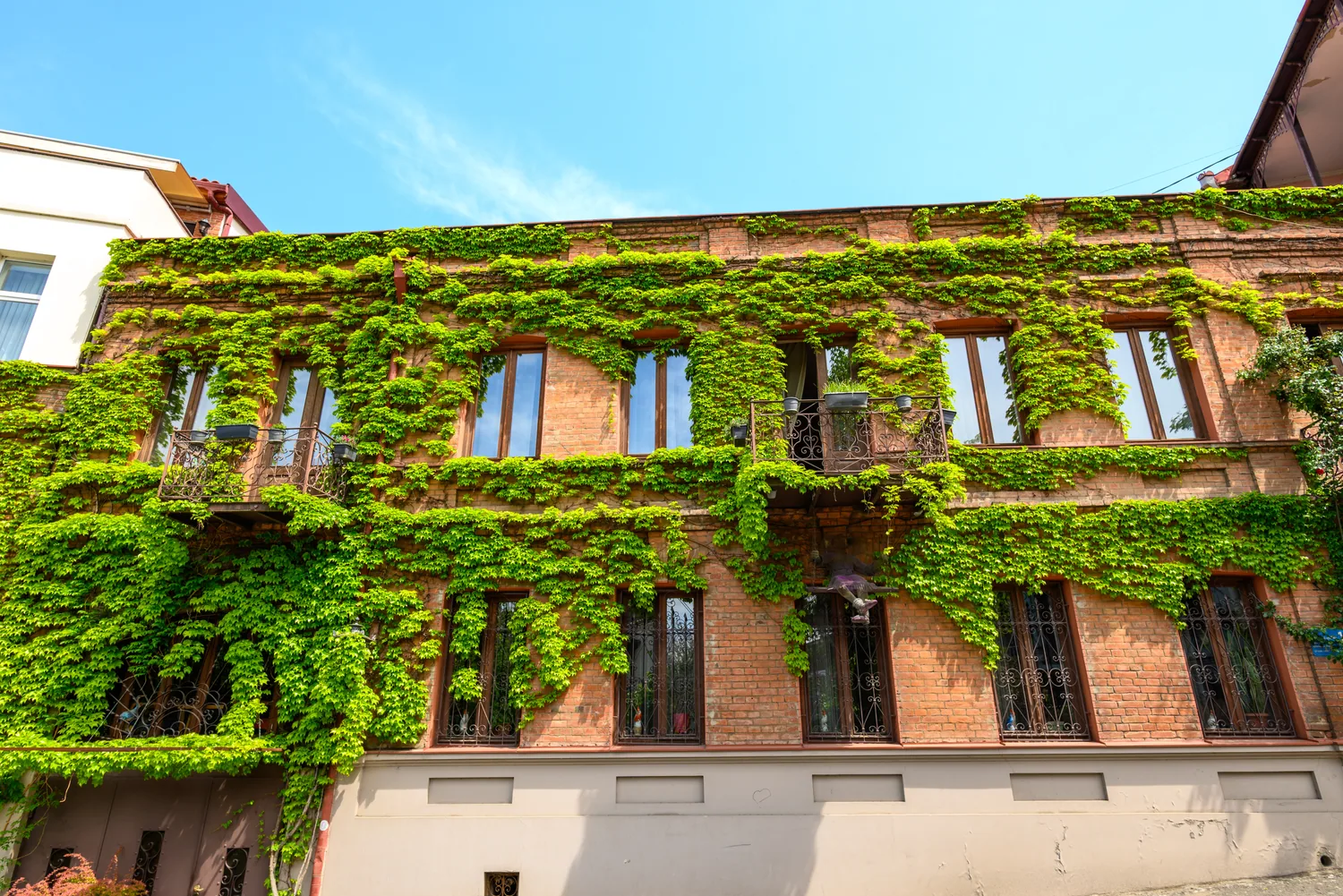
I suspect that is why the story caught my eye. It was near the back of a magazine someone had left sitting around the TA’s office circa 2007, and it compared the subject of math to a vast invisible edifice covered in visible vines. You know something is there from the way it shadows the plain and bends the weather around it, but the only way to make out its shape is to read the vines clinging to it. The author, Greg McColm, uses this to discuss different views on what is real, what is invented, and what is discovered. I just love the imagery, and it has stuck with me all these years. You can see in your mind’s eye how the growth traces out walls and cornices and turrets that no one has ever laid eyes on. Down at the base the vines are old and thick and orderly, arithmetic and algebra and geometry and calculus, pruned by generations of teachers into something a beginner can climb. Higher up the tangle thins into number theory and stranger things, where a single tendril may be the only sign that a turret is there at all. What I find honest about the metaphor is that McColm never lets the vines off easy. Their shape reflects the building, but it also reflects the gardeners, our fashions and funding and habits of teaching, so we are never quite sure how much of the outline is the thing itself. No one knows how big the edifice is, and we are surely missing whole wings of it. McColm never quite says the building is real. The vines are real enough, and they seem worth tending.
A few days ago OpenAI announced that it had produced a proof of the Navier-Stokes Millennium Problem. When I read the news, I thought about the vines. The result shows that a smooth fluid given a smooth push can tear itself into a singularity in finite time, so a wall some expected to run clean simply stops partway up. McColm anticipated this kind of moment. “But suppose your tendril encounters something unexpected, like an open space amidst some projections. A barred passageway? Exhilarated but anxious, you explore this strange opening.” Nothing is settled yet. The Clay Institute has accepted no proof, OpenAI says it will not claim the prize, and there is an unresolved argument about credit, since the work began after rumors spread that other mathematicians were already closing in. Still, the vines seem to be growing faster these days, and they are reaching places no one could climb to before.
This is the most incredible machine humanity has ever built. That was also my thought in 1987 the first time I walked into a computer lab, in 1995 when I logged onto the web, and in 1998 when I saw a classmate solve an integral on the TI-89. Each time, I thought I had seen something fundamentally new. But in just the last couple years, AI has gone from a rather clumsy calculator that needed me to give it hints to a competent system solving problems I don’t really understand how to even define.
My hope is that the vines remain visible and maybe, just maybe, we’ll be lucky enough to make out an architecture richer than anyone could have dreamed of. As I sit here tending my little corner of the garden in West Central Minnesota, I am watching the show from afar, astonished by the speed at which the frontier is moving. The garden’s a busy place these days.
Ref: Greg McColm, “A Metaphor for Mathematics Education,” Notices of the American Mathematical Society, vol. 54, no. 4 (April 2007), pp. 499–502. ams.org